Apple's stock rose just 1%. Why did it just become the world's most valuable company?
Apple has overtaken Nvidia to become the world's most valuable public company. On Monday, July 27, Apple closed with a market cap of about $4.94 trillion, edging past Nvidia's roughly $4.83 trillion. Apple's stock didn't do anything dramatic that day, rising only about 1%. The real reason the crown changed hands lies elsewhere.
Did Apple actually earn this
Apple is up 22% for the year. But its capital spending has actually declined for three straight quarters, running against the grain while every other big tech company pours money into AI infrastructure.
 Apple Overtakes Nvidia as Most Valuable Company as iPhone Maker Avoids Capex Pitfalls (Yahoo Finance, 2026-07-27)
Jay Woods, chief market strategist at Freedom Capital Markets, put it this way: "Once criticized for not spending more on AI, they have been able to avoid some of those capex pitfalls."
Why Alphabet and Tesla moved the opposite way
The same week, Alphabet and Tesla got the opposite report card. Alphabet's stock fell after it raised its AI infrastructure capex outlook. Tesla's did too, after it said it would spend more on robotaxis and robotics. Alphabet is still up 3% year to date. Tesla is down 30%. Companies that held back on spending got rewarded this week. Companies that opened the spigot got punished.
Why chip stocks are down a third straight day
The bigger picture isn't that Apple rose. It's that chip stocks fell. The Philadelphia Semiconductor Index has now declined for three consecutive sessions. ASML dropped more than 7%, AMD over 8%, Nvidia around 5%, and Micron close to 6%. Equipment makers Applied Materials, Lam Research and KLA slid too.

The trigger was China. A state-backed, Shanghai-based firm reportedly began mass-producing its own DUV lithography machines, stepping into territory ASML has effectively owned alone. Stacks has already covered what that machine can and can't actually do.
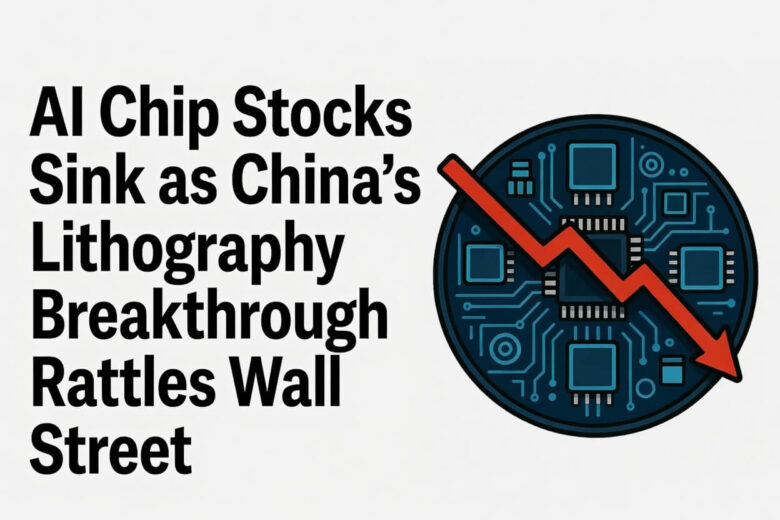 AI Chip Stocks Sink as China's Lithography Breakthrough Rattles Wall Street (Babypips, 2026-07-27)
The market didn't even open lower that day. Oil dropped more than 8% as the US and Iran paused strikes, and news broke that Nvidia would guarantee $250 billion of OpenAI's financing, both bullish headlines. Stocks opened higher, then chip weakness dragged the market back down by afternoon. That reversal is what makes this selloff notable.
Apple got rewarded for capital discipline, holding back on spending while everyone else overspent. This is a win for restraint.
Apple only rose 1%. The crown changed hands because Nvidia fell 5%, not because Apple did anything unusual.
Both readings look at the same numbers. They just weigh them differently.
What else is stacked into this week
The same day, Chinese memory maker CXMT went public in Shanghai and briefly became the country's most valuable listed company, a story Stacks has already covered. The Fed's rate decision lands Wednesday, with futures markets split between a hold and a hike. Apple reports earnings Thursday, and it will be Tim Cook's last call as CEO. He steps up to executive chairman on September 1, when John Ternus takes over as chief executive.
What to watch from here
The real question is whether this crown change sticks or reverses in a day. If Apple's Thursday guidance shows capex climbing again, this week looks like a chip-driven blip. If Apple keeps holding the line on spending and still delivers, the capital-discipline reading gains ground. One company that spent less and companies that spent more got opposite scores this week. Whether that's a coincidence or a sign the market is rewarding restraint differently now won't be clear until earnings season wraps.
- Apple's $4.94T market cap passed Nvidia's $4.83T, making it the world's most valuable company.
- On the surface this looks like an Apple win, but Apple only rose 1% that day.
- The real driver was a three-day chip stock selloff triggered by China's homegrown DUV lithography news.
What happened next
Awaiting gradingTo be scored in the first run of August: whether Apple's Thursday (7/30) earnings show capex guidance climbing again, and whether Apple holds onto the market-cap lead.