India's EUR 5.5 billion, oil products' 45%, and Russia's total 12%
#IndiaWatch🇮🇳: India imported a RECORD €5.5B of Russian crude in July, its SECOND consecutive monthly record.
RUSSIA = BIG WINNER FROM TRUMP’S WAR ON IRAN.
India bought EUR 5.5 billion of Russian crude oil in July, a record for the second month running and 2.1% more than in June.
 July 2026 monthly analysis of Russian fossil fuel exports and sanctions (Centre for Research on Energy and Clean Air, 2026-08-10)
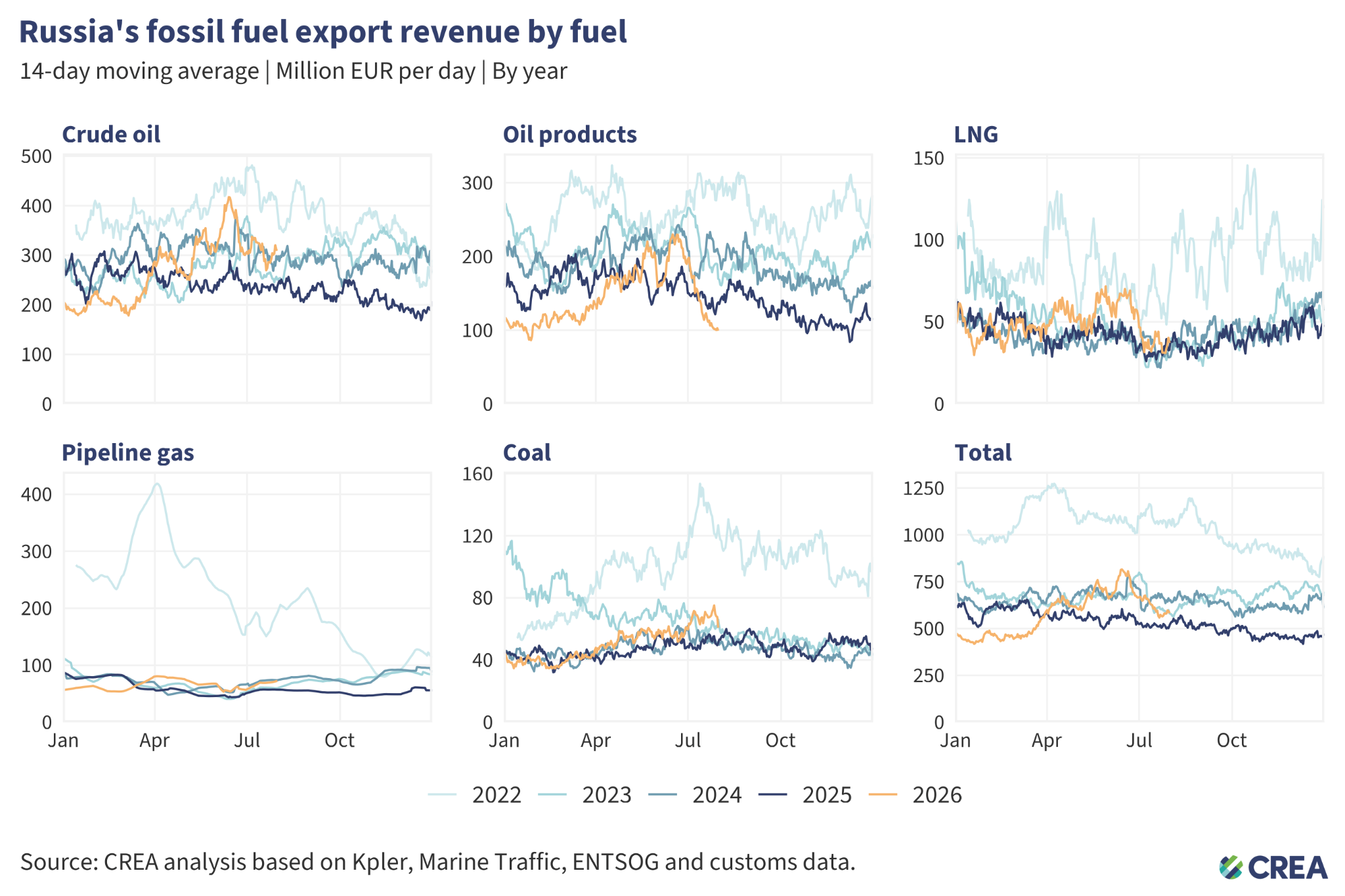
That number is being read as proof that Russia is the big winner of this war. Another line in the same report says the opposite: what Russia earned from selling fossil fuels actually fell in July. It came to EUR 683 million a day, 12% less than in June.
Crude held up, refined products collapsed
A single stream, crude, is carrying more than half the total. The 12% fall came not from India buying less but from the products side giving way.
CREA July 2026 monthly report (2026-08-10) · "everything else" is the total minus crude and products · retrieved 2026-08-12
Crude export revenue held at EUR 392 million a day, essentially flat on June and up just 1%. Revenue from seaborne oil products, meanwhile, fell 45%. Crude and products are the same oil sold in different states. Crude comes out of the ground and goes straight onto a ship. Products go through a refinery first and leave as diesel or jet fuel. The processed side fetches more, so when that stream gives way, the same barrels leave less money behind. The price is still being held down as well. Urals averaged USD 60.22 a barrel in July, 3% below June, and the discount to Brent stayed at 26%, or USD 21 a barrel. Russia is selling plenty. It is not selling at full price.
What India agreed to in February
There is one more thing behind this run of records. In August 2025 the United States added 25 percentage points to tariffs on Indian goods over those crude purchases, taking the total to 50%. Then on February 2, 2026, that rate was reported to have come down to 18% as India agreed to stop buying Russian crude.
 Trump to slash US tariffs on India from 50 percent to 18 percent (Al Jazeera, 2026-02-02)
The tariff came down; the buying went to back-to-back records in June and July instead. India takes 37% of Russia's crude exports, the second-largest share, and China takes 50%. Between them, close to nine of every ten barrels Russia exports flow to those two countries.
The bill that cleared the Senate on August 8
On August 8 the US Senate passed, 86 to 11, a bill giving the president authority to impose tariffs of up to 100% on large buyers of Russian energy. It still needs the House and a signature, so no tariff has taken effect. The longer India keeps buying discounted crude, the stronger the case for actually using that authority becomes. Seen from Moscow, though, what remains is that even a record month in India can sit inside a fall in total revenue. If the August tally due in early September puts India above EUR 5.5 billion, the February undertaking has gone unmet for a third month; if it comes in below, the run of records stopped in July.
- India bought EUR 5.5 billion of Russian crude in July, a record for the second month running.
- On the surface, the sanctioned side looks like it is selling better than ever.
- Yet Russia's fossil fuel revenue fell that same month, because revenue from seaborne products was cut roughly in half.
Scheduled for gradingAwaiting grading
Sources
- Original Steve Hanke (@steve_hanke) · 2026-08-12
- Primary source Centre for Research on Energy and Clean Air, July 2026 monthly analysis · source of import bills, export revenues, Urals prices and country shares
- Report Al Jazeera 2026-02-02 · US tariffs on India cut from 50% to 18%
- Report American Bazaar 2026-08-08 · the US Senate passes, 86 to 11, a bill authorising tariffs of up to 100% on buyers of Russian energy
Retrieved 2026-08-12 · import bills, export revenues and Urals prices follow CREA's July 2026 monthly report, published 2026-08-10. In the share band, "everything else" is daily total revenue minus crude and oil products. The Senate bill has not passed the House or been signed, so no tariff is in force.