One month after the joint venture was set up, the start date moved back a year
Samsung Electro-Mechanics Flashes Red on Glass Substrate Customer Evaluation... Investment Pushed Back Too
Samsung Electro-Mechanics' investment schedule for semiconductor glass substrates is slipping. A bottleneck has emerged in the customer's prototype reliability evaluation.…
Samsung Electro-Mechanics has pushed the start of glass substrate mass production out to 2028. The revision came less than a month after the company set up a joint venture and named the second half of 2027 as its start date.
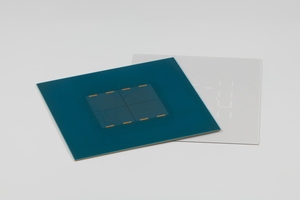 Samsung Electro-Mechanics forms 480 billion won glass core joint venture with Sumitomo unit (The Korea Herald, 2026-07-02)
The Korea Herald reported on July 2 that Samsung Electro-Mechanics was setting up a joint venture capitalized at 480 billion won with Dongwoo Fine-Chem, a subsidiary of Japan's Sumitomo Chemical. Samsung Electro-Mechanics holds 66.2 percent and Dongwoo Fine-Chem 33.8 percent. The plant goes inside Dongwoo Fine-Chem's Pyeongtaek campus, and the share purchase was set to close on September 1.
Why glass substrates matter
The board a chip sits on is called a substrate. Today it is built by stacking layers of a plastic-based material. The wider you make that board, the more it bows, and heat makes it stretch. The chip does not stretch, so when only the board does, the thousands of joints connecting the two go out of line. Glass stays flat and stretches far less under heat. That lets a package carry bigger chips packed closer together. Put simply, the industry has been stacking heavy things on a soft wooden cutting board, and glass swaps that board for marble. The catch is that glass cracks. The customer who will buy the chips runs its own tests: hundreds of heat and cool cycles to see whether the board fractures, and pressure tests to see whether it holds. That process is called reliability evaluation.
The reliability evaluation is where this stopped
According to industry officials quoted in the original post, the halt came because Samsung Electro-Mechanics did not obtain reliability certification from a global communications chip customer. The prototype has to be rebuilt and resubmitted, and because that cannot be done in a week or two, whether the line investment happens at all this year is now said to be uncertain.
- 2025-11
First equipment order schedule given to supplier partners
- 2026-06
Guidance stops after the order date slips for a third time
- 2026-07-02
GlaSSEM joint venture with Dongwoo Fine-Chem set up, targeting second half of 2027
- 2026-07-31
Second quarter earnings call moves the start of operations to 2028
- 2026-09-01
Scheduled closing of the GlaSSEM share purchase
This is not the first slip. The earlier three came with a new date attached; this one did not.
Checked 2026-08-12, from the original post and Korea Herald reporting of 2026-07-02
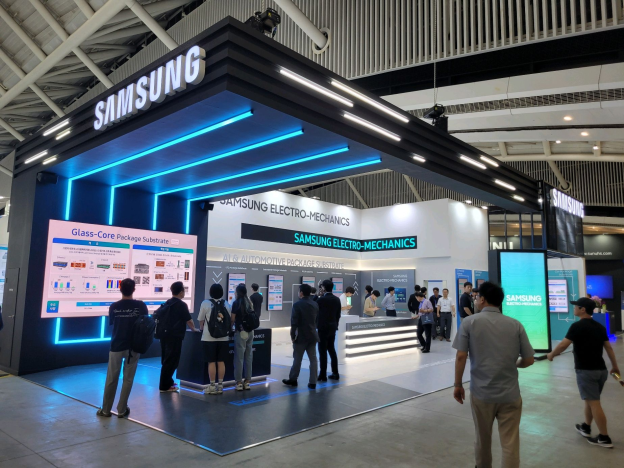 Samsung Electro-Mechanics reportedly to form glass core JV with Sumitomo unit, targeting 2H27 production (TrendForce, 2026-07-06)
TrendForce carried the same second-half-2027 target in a July 6 article. The schedule the outside world wrote down and the schedule the company revised a month later part ways right there.
Deposition tools set the clock
Deposition equipment has the longest gap between order and delivery. So the plan was to order deposition tools first, move the main process equipment into Pyeongtaek by April next year, and finish the initial line within the second quarter. Allowing for how long the tools take to build, even an order placed this year leaves the line standing only in the second half of next year. As recently as last month, equipment makers expected orders to start in August.
If the deposition order lands inside 2026
If the deposition order goes out this year, the revised 2028 start holds. If it does not, 2028 slips too. The longer Samsung Electro-Mechanics is late, the longer anyone trying to build a bigger accelerator package has to keep using plastic-based boards. The bowing problem grows with the size of the board, so the burden gets heavier the further out this runs. Whether this is one company's delay, or a signal that glass substrates are a post-2028 story altogether, is decided by the same order.
- In early July, Samsung Electro-Mechanics set up the GlaSSEM glass core joint venture and named the second half of 2027 as its start date.
- Less than a month later, at the July 31 second quarter earnings announcement, it moved that start to 2028.
- What happened in between was a failed customer reliability evaluation, and the equipment order schedule has now vanished for the fourth time since November 2025.
Scheduled for gradingAwaiting grading
Sources
- Original Jukan (@jukan05) · 2026-08-12
- Joint venture capital, ownership and location The Korea Herald, 2026-07-02
- Second half 2027 production target TrendForce, 2026-07-06
Checked 2026-08-12. The 480 billion won capital, the 66.2 to 33.8 ownership split and the Pyeongtaek site come from Korea Herald reporting of 2026-07-02. The revision of the start date to 2028 and the failed reliability evaluation are Korean press accounts relayed by the original post, and could not be confirmed against a Samsung Electro-Mechanics statement.
This author's record
- BullKorea's DRAM module exports in the first eleven days of August were 4% of July'…
- BullOn August 5, China's CXMT turned down Apple's price-cut request
- BullThe business SK hynix bought for $8.85 billion now carries a $35 billion price…