Two earnings reports landed on the day chip stocks crashed together, revenue up 165% and 104%
I personally see it as extreme short term deleveraging that overshot many individual names.
Think earnings season tend to remind markets about continued AI acceleration.
But as a TLDR, looks very positive for the themes I'm tracking.
On July 28, while chip stocks fell together, two second-quarter results released the same day pointed the other way. Bloom Energy grew revenue 165.5% year over year to $1.0654 billion, and Teradyne grew 104% to $1.329 billion.
What do these two companies sell
Bloom Energy builds fuel-cell power units that sit next to a data center. Instead of pulling electricity off the grid, you feed the unit gas and it makes the electricity on site. In a country where ordering a new large transformer means a three-year wait, that is the detour a data center takes to get powered.

Its gross margin rose to 33.4% from 26.7% a year earlier, and its operating margin swung to 17.1% from negative 0.9%. The company also raised full-year revenue guidance to $3.9 billion to $4.2 billion. Teradyne sells the machines that check whether a finished chip actually works. Orders for test equipment track how many chips are physically coming off the line, which puts them a step ahead of most demand signals. Its earnings per share went from $0.49 a year ago to $2.38.
Both companies supply the AI data center build-out. On the reported numbers, a break in demand has not shown up yet.
2026-07-28 · company second-quarter releases (Business Wire)
So why did the stocks go the other way
Serenity, who wrote the original post, reads the gap as extreme short-term deleveraging that overshot individual names. When positions bought with borrowed money get unwound at once, good results and bad results get sold alike. These earnings are the evidence he leans on, along with Alphabet lifting its 2026 capital spending plan to $195 billion to $205 billion.
The peak in AI capital spending is showing up in chip stocks first.
Demand is still accelerating in the numbers; what is being sold is leverage, not the thesis.
One side is looking at future demand and the other at the identity of today's seller. The split is not about the forecast. It is about who is selling.
Why Korea fell harder, for a reason of its own
There is one thing the original post does not cover. Korea has a pool of money that can only move in one direction right now. The 30 million won minimum cash deposit rule on single-stock 2x leveraged ETFs tracking Samsung Electronics and SK Hynix was pulled forward to July 31, and from that date only cash actually settled in the account counts. Proceeds from selling shares count only two days later, when settlement completes. In practice, averaging down as the price falls becomes much harder.
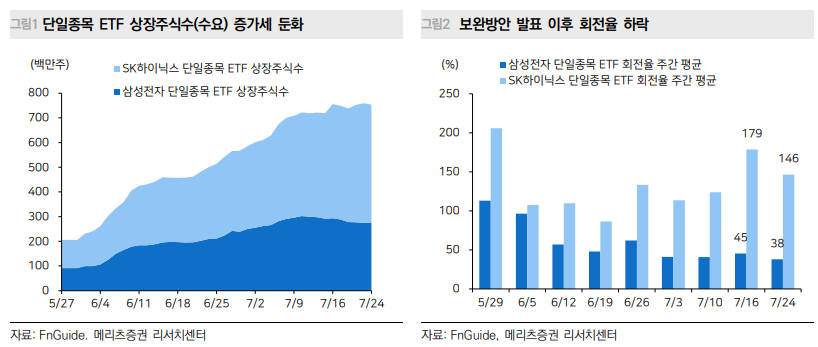 Cash-only 30 million won threshold on single-stock leverage, will churn fall? (Etoday, 2026-07-27)
That report measures weekly average turnover in the SK Hynix single-stock ETFs falling from 179% to 146%. The Samsung product fell from 45% to 38%. Money was already leaving these products before the rule took effect, and that selling has nothing to do with what Bloom Energy or Teradyne reported.
What settles it
The question comes down to one thing. Is this selling because demand cracked, or because leverage is being unwound? Two things can settle it. If Teradyne hits the $1.2 billion to $1.3 billion of third-quarter revenue it guided to, the demand explanation weakens. If it misses, this was more than mechanical selling. The Korean piece is simpler. If the declines continue after July 31, the deposit rule was not the cause; if they stop, much of it was. When earnings and flows move on the same screen, only the lag tells you which one was driving.
- On July 28, while chip stocks fell together, Bloom Energy and Teradyne reported second-quarter revenue up 165.5% and 104% respectively.
- Serenity, who wrote the original post, reads the gap as short-term deleveraging that overshot individual names, a case of leverage being unwound rather than demand cracking.
- But Korea fell harder for a reason of its own: the 30 million won cash deposit rule on single-stock 2x leveraged ETFs was pulled forward to July 31.
What happened next
Awaiting gradingScore at Teradyne's third-quarter report on whether it actually delivers the $1.2 billion to $1.3 billion of revenue it guided to.
This author's record
- BullThe 'Photonics CEO' Who Said Pluggables Have 10 Years Left Runs a Laser Supplie…
- BullTesla stock lost $140 billion in a day. Musk spent the earnings call talking ab…
- BullAlphabet's Q2 beat blows past estimates, and Google raises 2026 capex guidance…