Safety is not the only reason Nvidia opened its driving model
Today, we're launching Alpamayo 2 Super, our frontier open reasoning model for autonomous vehicles.
We're releasing it for commercial use under OpenMDW-1.1 so teams can inspect it, fine-tune it and deploy it—open models advance safety and security.
Nvidia released the weights of a 34-billion-parameter self-driving model on 4 August. Anyone may download them, take them apart, change them, and make money with the result.
 Alpamayo 2 Super model card (Nvidia on Hugging Face, 2026-08-04)
Weights are the pile of numbers a model ends up holding once training is over. With them in hand you can run the same model on your own machines instead of renting someone else's server. In car terms, what is being handed over is the blueprint rather than the finished vehicle.
What opened today is the licence, not the model
Alpamayo 2 Super is not new to the world. Nvidia announced it on 31 May and promised that weights and inference code would follow in the summer, and that promise was kept on this day. Two months sat between the promise and the delivery. The licence attached to it, OpenMDW-1.1, is a permissive open licence written under the Linux Foundation, and it allows commercial use. A robotaxi operator or a carmaker may put this model inside a product and sell it. May brought the announcement; this day brought the key.
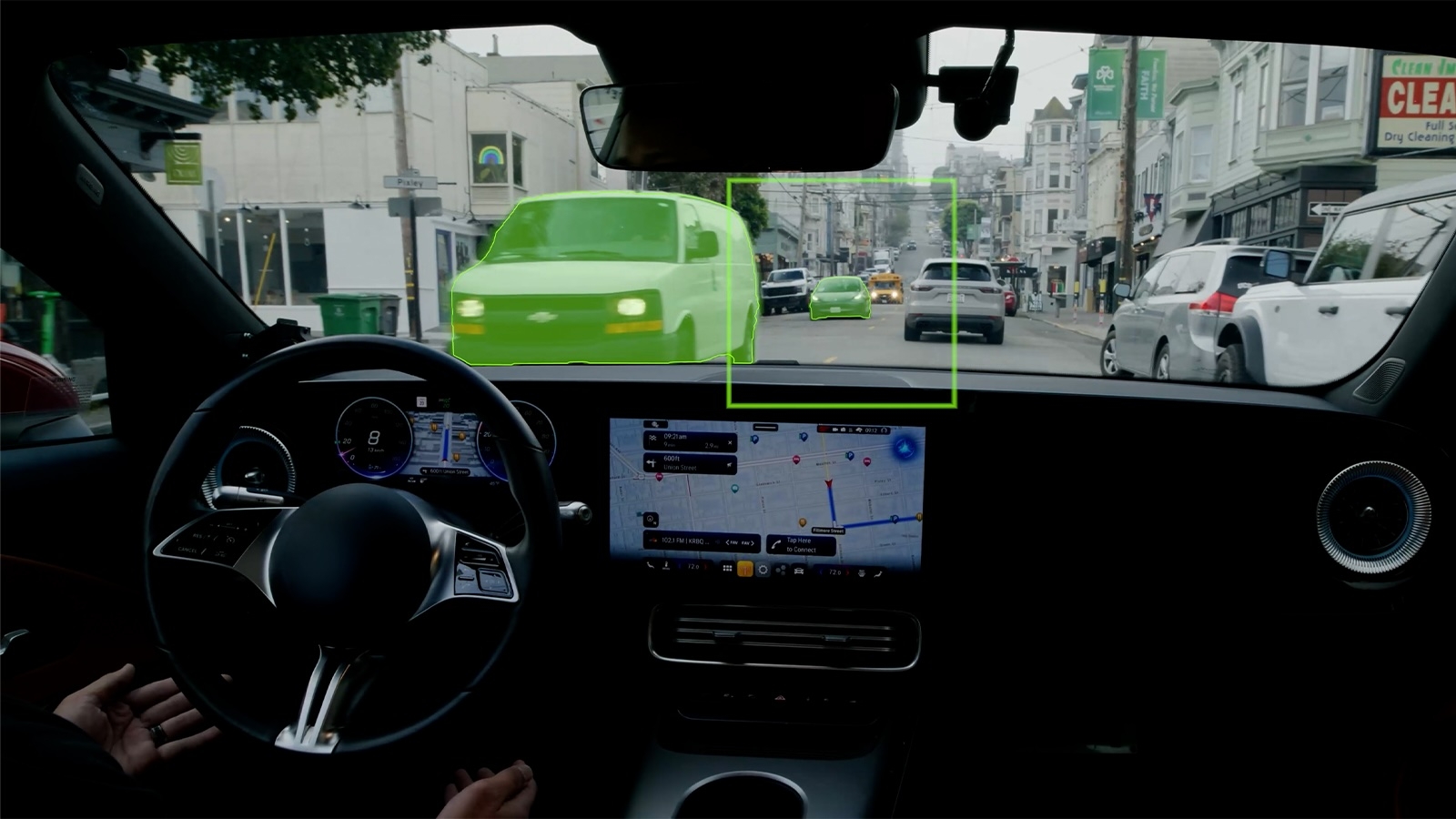 Nvidia launches Alpamayo 2 Super open reasoning model for robotaxis (Nvidia Newsroom, 2026-05-31)
The model card puts the training material at roughly 115,000 hours of multi-camera driving video. Human driving was fed in whole, and the model was built to output both the path it intends to take and the reasoning behind it.
What it takes to run this once
The larger one is what got opened. As the model grew, so did the machine needed to run it.
Nvidia press release (2026-05-31) and Hugging Face model card (2026-08-04)
Nvidia tested it on a single H100, and 72 of the card's 80 gigabytes of memory were in use.

Releasing the weights does not turn the model into something that runs on a laptop. Using it requires a data-centre-class card, and the company that sells that card is the company that opened the model.
What OpenMDW-1.1 opens
Giving something away looks like a loss until the arithmetic is done from the other side. If companies that used to build self-driving software from scratch all start from the same model, the chip that runs that model best sits in the standard's seat. Nvidia hands over the model and sells Drive Thor and Hyperion, the computers that go into the car. That is why the pattern is being described as giving away the model and selling the silicon.
 Nvidia opens up Alpamayo 2, a driving model that reasons out loud (The Next Web, 2026-08-04)
The same report kept its doubts on the table. Benchmark scores do not translate directly into road performance, and the memory the model demands limits where it can actually be put to work. Opening it for safety and opening it to set the standard do not push each other out. Both can be true, and both probably are. One thing will separate them. If a company shows up running this model for money on hardware that is not Nvidia's, the opening earned its name; if none ever does, this release is better read as standard-setting.
- The era of every company building self-driving software from scratch is closing. Once the starting point is shared, what separates players is hardware rather than software.
- The open model occupies a whole data-centre-class card. Opening it does not widen where it can run, and the company selling that hardware is the one that opened it.
- Whether anyone makes money running this model on non-Nvidia hardware is what will price the openness.
Sources
- Original Jensen Huang (@JensenHuang) · Alpamayo 2 Super released for commercial use · 2026-08-04
- Hugging Face model card 34bn parameters · OpenMDW-1.1 licence · about 115,000 hours of driving video · tested on one 80GB H100 with about 72GB peak use (2026-08-04)
- Nvidia Newsroom Announcement date, the 10bn-parameter previous generation and the summer weights promise (2026-05-31)
- The Next Web The give-away-the-model, sell-the-silicon rationale and doubts about benchmarks and memory (2026-08-04)
Retrieved 2026-08-04 · parameters, licence and memory requirement from the Hugging Face model card updated the same day · previous-generation size and announcement date from Nvidia's press release of 2026-05-31