Why did the pension fund that always bought Korea's trading halts sell into five of them this year?
2026년에 발동된 서킷브레이커 9번 중 국민연금이 매수가 아니라 매도를 선택한 것이 5번이다.
국민연금이 리밸런싱을 제때 하지 못했기 때문에, 매수 여력이 없었기 때문이다.
국민연금 연초 대비 평가이익이 314조 원에서 95조 원으로 219조 원이 줄어들었다는 계산이 나온다.
When Korean stocks fell hard enough to halt trading, the National Pension Service used to be the buyer. Six circuit breakers were triggered between the system's launch in December 1998 and the end of 2025, and the fund put money to work in all six. 2026 broke the pattern. Of this year's halts, the fund chose to sell rather than buy on five of them.
 Bourse operator issues circuit breaker for KOSPI on sharp fall (The Korea Times, 2026-07-29)
The exchange halted trading for 20 minutes at 12:31 p.m. on July 29 after the KOSPI fell more than 8% from the previous close. The exchange counted that halt as the eighth of the year. The original post counts nine, and the gap appears to come from whether KOSDAQ halts are counted alongside.
Why the fund could not buy
The National Pension Service fixes in advance how much of the total fund domestic equities may occupy, and when a rally pushes the holding above that share, it sells to bring the weight back down. That is rebalancing. The part that matters is not the selling but what the selling produces. Cash trimmed during a rally is the cash available to buy during a crash. Think of a shopping basket with a set ratio per compartment: whatever you take out of an overflowing compartment is what you spend next time.
The rule changed in May
On May 28 the fund's management committee raised the domestic equity target from 14.9% to 20.8%. The change answered a complaint that mechanical selling into every rally was pressing down on the market.
 NPS raises domestic stock target to 20.8% amid market pressure (Seoul Economic Daily, 2026-05-28)
Seoul Economic Daily reported that the actual domestic equity weight sat near 30% when the decision was made. Lifting the target by 5.9 percentage points still left the real holding more than 9 points above it. Even with a wider allowance, the fund stayed on the selling side.
Widening the band by 5.9 points was meant to curb forced selling into rallies. Selling less during a rally also means banking less cash for a crash. The lack of buying power the original post points to shares a root with this rule change, separate from any judgment about fund management.
Retrieved 2026-07-30 · NPS Fund Management Committee decision of 2026-05-28, as reported by Seoul Economic Daily and KED Global
The fund failed to rebalance in time and missed its moment. It erased its own firepower through poor management.
The wider band adopted in May to reduce forced selling into rallies also reduced the cash available to buy into a collapse.
The same fact splits on whether you read it as a management miss or as the back side of a rule changed to help the market.
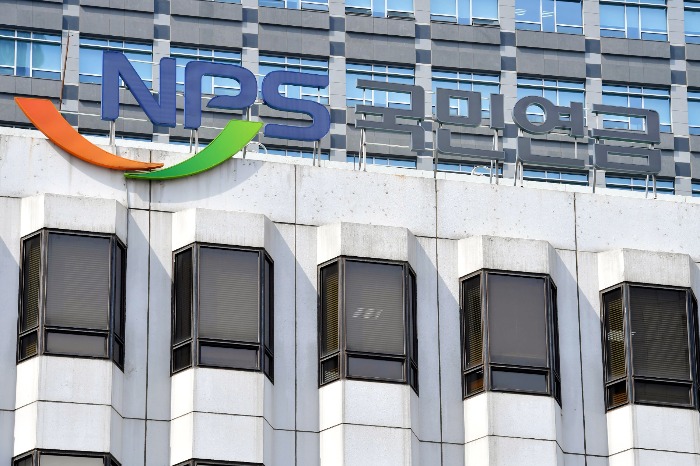 NPS sits out Korea rout as wider equity bands blunt rebalancing (KED Global, 2026-07-29)
KED Global argues that the wider allocation band, introduced to curb forced selling into rallies, also dulled the fund's ability to buy aggressively into a collapse. The same article notes that the fund made only modest purchases even on July 28, when the KOSPI closed 10.84% lower at 6,023.66.
What the missing 219 trillion won was
At a KOSPI of 9,100 on June 19, the fund's year-to-date paper gain stood at 314 trillion won. With the index closing at 5,663 on July 29, the same calculation gives 95 trillion won. A paper gain is the amount written into the books for an asset that has risen in price but has not been sold. It is not money in hand. It is an estimate of what the money would be if sold. So when the price retreats, the entry is erased with it. By the original post's arithmetic, delaying the fund's depletion date by one year costs 49 trillion won. That makes 314 trillion won worth 6.4 years and 95 trillion won worth 1.9 years.
How we will know
In the end there is one question. Is the buying that resumed in late July the safety net returning, or simply what falls out once the weight has drifted back under the cap. The 116 billion won bought on July 28 and 338 billion won on July 29 are far larger than the 48 billion won of June 8 or the 29 billion won of July 7. Set against the 573 billion won of March 13, 2020, they are still small. If the next halt brings buying in the trillions of won, the constraint has genuinely loosened. If the figure falls back to the low hundreds of billions, this week's purchases were the mechanical result of a weight that had already come down. Acting as the market's safety net was never the fund's objective. The objective is return, and the safety net was a by-product of chasing it. What remains is that this year the by-product went missing.
- Six circuit breakers hit Korea between the system's launch in 1998 and the end of 2025, and the National Pension Service bought in all six.
- 2026 broke the pattern. The fund sold rather than bought on five of this year's halts, and when it did buy the sums were in the hundreds of billions of won.
- The turn came on May 28. Raising the domestic equity target from 14.9% to 20.8% cut the forced selling into rallies, and cut the cash available to buy a crash with it.
What happened next
Awaiting gradingScore at the next KOSPI circuit breaker: net buying above 1 trillion won means the constraint genuinely loosened, while a figure back in the low hundreds of billions means the purchases were mechanical.
This author's record
- BullHouthis strike two Saudi-owned tankers by name, following through on a five-day…
- BullMeru: Alphabet raises 2026 capex to $195-205B even as free cash flow turns nega…
- BearKolon TissueGene's TG-C fails US Phase 3 trial, placebo outperforms on pain rel…