The 12,800Mbps on CXMT's LPDDR6 is China's lithography limit written into a spec sheet
According to a source cited by Chinese media, CXMT has made further progress in developing LPDDR6, with development validation now nearing completion and mass production one step closer.
It features 16Gb memory dies and a total package capacity of 16GB, using a 1,295-ball PoP package.
The design data rate of the first LPDDR6 that China's CXMT has built is 12,800 megabits per second. SK hynix, preparing the same standard, is targeting 14,400, and the limit of the lithography China can get its hands on sits inside that difference.
 CXMT closes in on LPDDR6 mass production (China Daily, 2026-08-03)
China Daily reports CXMT is wrapping up development validation on its first LPDDR6, built on 16-gigabit dies for 16 gigabytes of packaged capacity in a 1,295-ball package-on-package design. The same piece adds that SK hynix holds the most advanced publicly disclosed position and is preparing mass production in the second half of this year.
What LPDDR6 is and why the speed matters
LPDDR is the low-power DRAM soldered directly onto the board of a phone or a laptop, and LPDDR6 is its newest generation. Unlike the stick that slots into a server, it is fixed inside the device, so it cannot be swapped later and the speed chosen at purchase stays for the life of the machine. Speed is written as how many megabits move per second. The more AI work a device runs locally, the more the bottleneck becomes fetching stored values, so this number decides what class of product a chip can go into.
CXMT's 12,800 sits above the 10,700 Samsung demonstrated at CES and 11% below SK hynix's 14,400. It is hard to call that either behind or caught up. What matters is why the top of the standard stays out of reach.
Retrieved 2026-08-03 · CXMT figures from the source post, SK hynix and Samsung targets as reported by TechTimes
Why the top of the standard stays out of reach
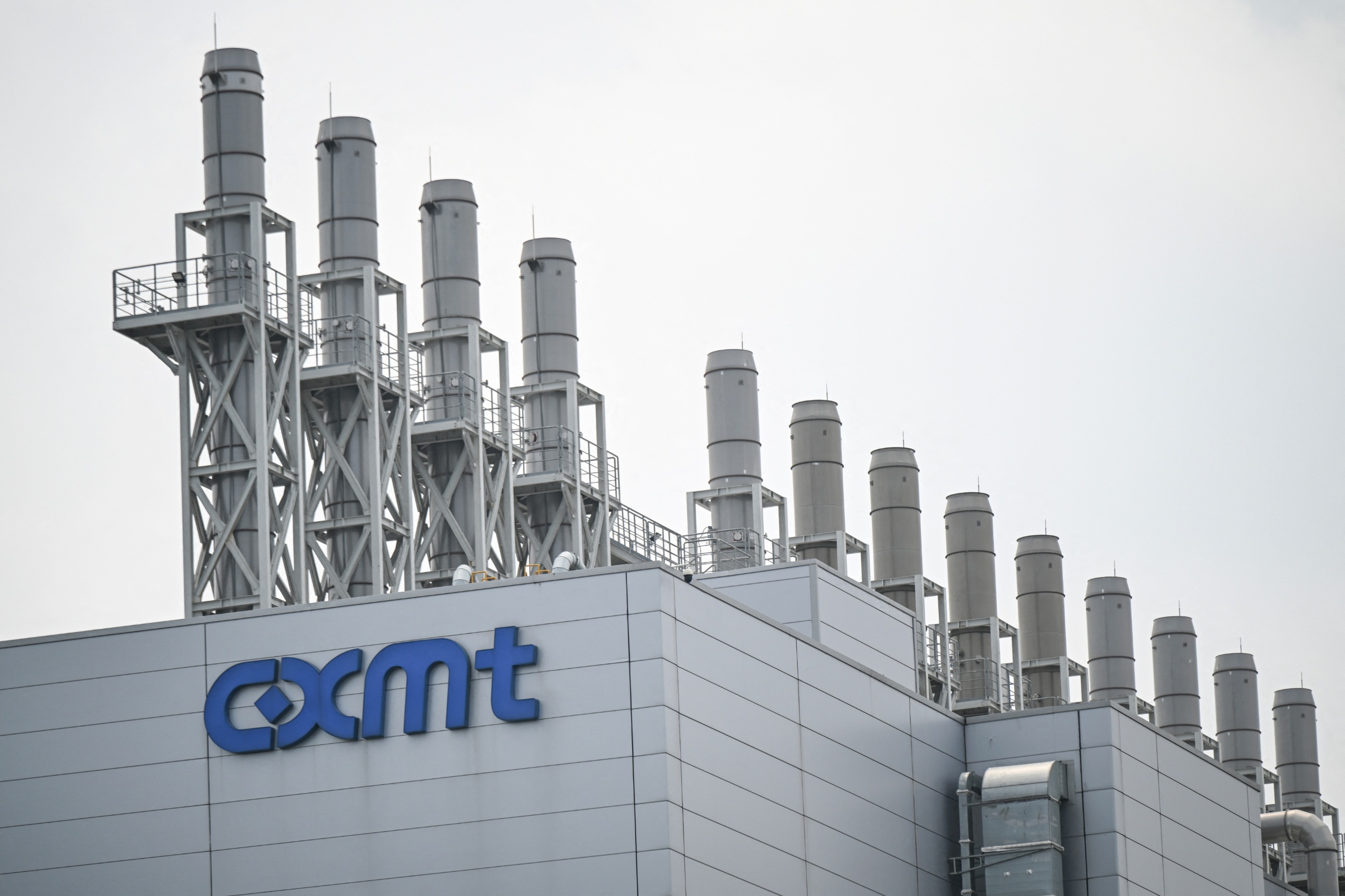 CXMT nears LPDDR6 production: the DUV ceiling shows up in the 12.8 Gbps vs 14.4 Gbps gap (TechTimes, 2026-08-02)
TechTimes traces the gap to how the circuits get printed. SK hynix prints in a single pass with extreme-ultraviolet tools at a 13.5 nanometer wavelength, while CXMT layers several passes with deep-ultraviolet tools at a longer wavelength. Layering passes means aligning the plate again each time, and a little misalignment accumulates with every pass. That accumulated error shaves the top speed the finished circuit can hold. The ceiling gets cut off during the sorting step, where finished parts are binned by the speed they actually reach. China has not been able to bring in a single extreme-ultraviolet tool. So the 11% is less a question of CXMT's design skill than of access to equipment.
So what settles it
The question comes down to one thing. Whether this is progress on the way to matching the standard, or a ceiling that stops just below its top. The next generation settles it. If 12,800 climbs to 14,400 within LPDDR6, multi-pass printing can reach the top after all, and if roughly the same 11% survives into the next generation, that is where the ceiling is. Chinese memory has taken the route of entering on price and climbing toward the standard. This number is the first time that road has been measured to the decimal. It is also how the phrase "lithography is the last bottleneck" ends up written into a product spec sheet.
- CXMT has entered the final stretch of development validation on its first LPDDR6, with a design rate of 12,800 megabits per second.
- On the surface it reads as China arriving at the newest mobile DRAM standard.
- But SK hynix, preparing the same standard, targets 14,400, and that 11% gap comes from not being able to use extreme-ultraviolet tools.
What happened next
Awaiting gradingScore when CXMT's LPDDR6 actually enters mass production and a device using it is disclosed. If the published rate stays around 12,800Mbps, the read that the printing method caps the top was right, and if it reaches 14,400Mbps, it was wrong.
This author's record
- BullNomura's three-year profit forecast for Samsung, 1,800 trillion won, tops its m…
- BullWhy does Samsung collect the full price increase on a five-year contract when M…
- BullIn the July that NAND export prices fell, Korea's computer exports rose 404%