Why did China build a 2008 model when it already held ASML's 7nm scanner?
They could not take the 1980Di apart and copy it, and got only as far as building the older model, the 1950i.
They say they reached 70% localization, but turned around that also means 30% of the key parts have to be imported before it can be built.
It was October 2025 when they took the 1980Di apart, failed to put it back together, and asked ASML for a repair.
The immersion scanner China says it has built sits at the same level as the NXT:1950i, a tool ASML released in 2008. It prints 28nm circuits in a single exposure, and the generation above it, the 2015 model 1980Di, is still out of reach. When a state-backed firm in Shanghai was reported on July 27 to have started volume production of the tool, ASML shares closed down 5.7% and fell as much as 7% intraday.
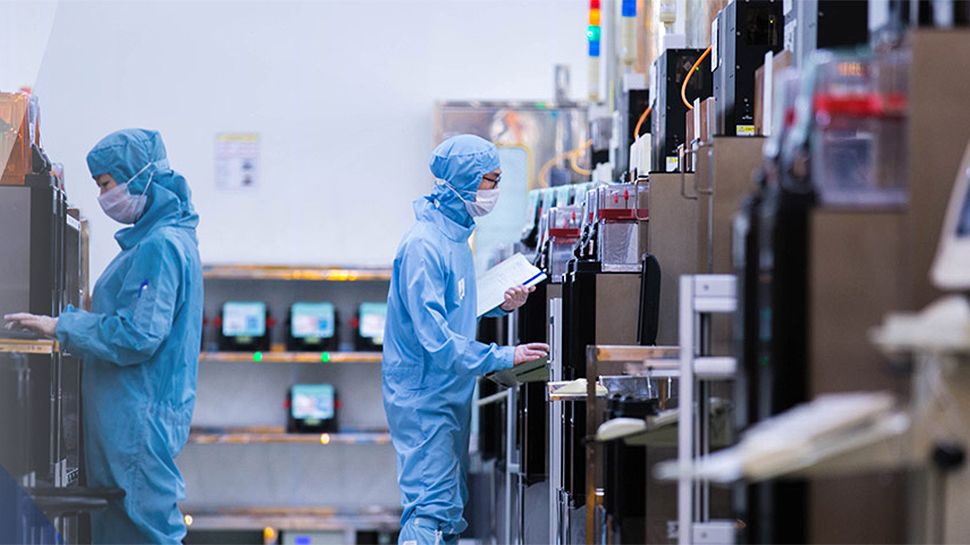 China begins mass production of homegrown immersion DUV machines, first units to SMIC, Hua Hong and CXMT this year (Tom's Hardware, 2026-07-27)
Tom's Hardware reports the tool prints 28nm-class features in one exposure and reaches 7nm-class when exposures are layered on top of each other. Deliveries run to about five units this year and roughly 20 next year.
Why a 2008 model of all things
A scanner is the machine that writes circuits onto a wafer with light. That single step eats 60% of the time and 35% of the cost of making a chip. Start with the light itself. The domestic source built by Keyihongyuan runs at 6kHz and 60W. ASML's part delivers 90W at the same frequency. For the optics, Maolai is said to have passed validation on a 300mm large-aperture lens. Its precision lands around 30nm, against under 10nm for Germany's ZEISS lenses, so ZEISS lenses were reportedly imported in the end.
 China's DUV lithography still lags ASML by four generations (Asia Times, 2026-07-31)
Asia Times names the tool the SSA800 and reports it was built by Shanghai Aishengna Electronic Technology Group, founded in 2023, which absorbed development teams from Yuliangsheng and SMEE. Roughly 70% of the parts are domestic, while mirrors for the 193nm excimer laser, ZEISS lenses, vacuum chambers and synchronization control algorithms are still imported. Turn that 70% around and it says 30% has to be bought from outside before the machine can be built at all.
Why the 1980Di could not be copied
Huawei already held the generation above. HSMC in Wuhan brought in an ASML 1980Di for a 7nm fab and then went bankrupt, and the Chinese government took over the company and handed it to Huawei. In October 2025, China asked ASML to repair that machine. The engineer who went on site reportedly found it taken apart and never put back together. Calibration is what stands in the way. It is a precision setting that aligns the lenses, mirrors and wafer stage down to the nanometer, fixed at the factory over weeks against hundreds of reference points. Opening the machine throws that alignment off, and the software key that restores it sits only with ASML. Even holding the finished product, you lose it the moment you look inside.
What ASML actually stands to lose
China moved fast because of the calendar. EUV was blocked from 2019, the NXT:2000i and above from late 2023, and the 1970i and 1980i from September 2024. Ninety units of the 1980i were stockpiled just before the rules landed, but servicing that lifts performance by more than 1% was banned too, which made upkeep hard.
The market China wants to win back with a domestic tool has already shrunk to about a sixth of ASML's sales. Export controls cut that share first, so what ASML newly loses if localization works is smaller by the same amount. The number points the same way the author does.
Retrieved 2026-08-03 · sales and net income from ASML's Q2 2026 results release, China share as reported by Tech Wire Asia
So what settles it
The question comes down to one thing. Whether this is the first crack in ASML's moat, or a detour that export controls forced open. The generation is what settles it. While the tool stays at 1950i class, it is a detour. The moment a 1980Di-class machine comes out of domestic parts alone, it is a crack. ASML took seven years to move from 28nm to 7nm. There is no visible reason the side walking that road again on a domestic light source and domestic lenses gets less time than that. A scanner is the one seat in the chip supply chain with no substitute, and whoever holds it is what gives export controls their leverage. That this tool sits at 2008 level says the leverage is still there.
- ASML shares closed down 5.7% on word that China had started volume production of a domestic immersion scanner.
- On the surface it looks like the last bottleneck in the chip supply chain has been broken open.
- But the tool sits at the level of the 1950i ASML released in 2008, and the 2015 model Huawei already held was taken apart and never put back together.
What happened next
Awaiting gradingScore at the end of 2027. If deliveries of the domestic immersion scanner stay near the reported 20 units and the generation stays at 1950i class, the author was right, and if a 1980Di-class tool comes out of domestic parts, he was wrong.
This author's record
- BullHouthis strike two Saudi-owned tankers by name, following through on a five-day…
- BullMeru: Alphabet raises 2026 capex to $195-205B even as free cash flow turns nega…
- BearKolon TissueGene's TG-C fails US Phase 3 trial, placebo outperforms on pain rel…