The node Samsung is putting in front of customers right now is not its most advanced one
As Samsung Electronics' HBM4 order volumes have surged, 4nm line utilization has shot up. The foundry's largest customer has become the memory division.
Samsung is absorbing even the smaller-volume customers pushed out of TSMC, so it is reaping spillover benefits on the 5nm process.
The node Samsung Foundry is now putting in front of customers is neither 2nm nor 4nm. It is 5nm. With the 4nm line booked out through next year, the sales pitch has shifted to offering fabless customers who cannot absorb the cost of a finer node the generation below it, where yields are already settled.
Filling a line and winning a customer are different things. This is still the distance between the two companies.
Retrieved 2026-08-05 · TrendForce release of 2026-03-12, based on 4Q25 revenue
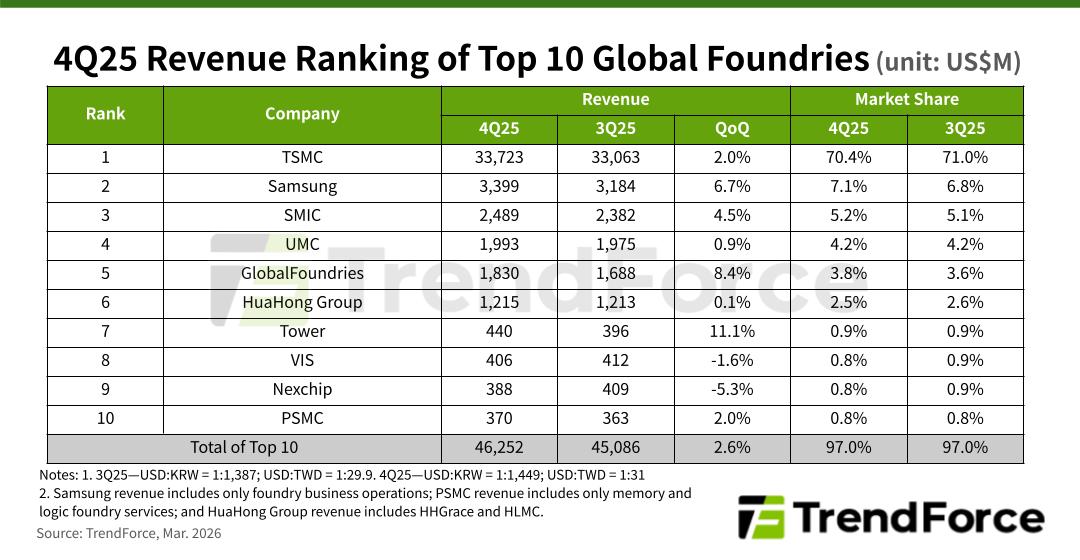 AI demand drives 4Q25 global top 10 foundry revenue up 2.6% QoQ, Samsung gains share (TrendForce, 2026-03-12)
Who filled the 4nm line
The largest customer filling that line is not an outside fabless firm. It is the memory division of the same company. HBM is a stack of DRAM layers, and the board at the very bottom that organises the signals and sends them out is the base die. Samsung builds that board not on a memory process but on the foundry's 4nm logic process. So the better memory sells, the fuller the foundry line gets. On top of that, industry sources say, came volume from Nvidia's dedicated inference chip. Nvidia licensed Groq's technology in December 2025 and unveiled the Groq 3 LPU at GTC in March 2026, a chip that uses no HBM at all and instead keeps 500 megabytes of SRAM on the die itself. The board that holds up HBM and the chip that refuses to use HBM are coming off the same 4nm line.

That article describes the Groq 3 LPU as a chip paired with Rubin GPUs and handed only the token-generation work. It fills in the part the original post names and moves past.
The road the pushed-out customers take
What Samsung is gaining right now is not leading-edge orders but the seats everyone else left behind.
The claim that Chinese and Indian fabless firms are coming to Samsung's 5nm to work around sanctions comes from a Samsung supply-chain partner, quoted anonymously. English-language reporting confirms only part of it. China's NIO already uses Samsung 5nm for its autonomous driving chip, and Samsung is reported to be in talks with BYD on autonomous driving SoCs. No Indian customer is named anywhere.
SF5A stands between cars and servers
The 5nm line is classified as SF5A, a process dedicated to automotive. Hyundai's ADAS chip targeting 2030 production, a system on chip from BOS Semiconductor, and an automotive application processor from Telechips are all booked on it. Automotive chips take years to qualify, and once they are in they stay for the life of the model. Putting server and AI orders in those slots lifts revenue now, but it shrinks the room that car volumes will need when they reach production a few years out. That is also why a full line does not immediately mean profit. Samsung's non-memory business is reported to have posted a loss of about 600 billion won in the second quarter of 2026. The split is whether this volume converts into share. If the outside customers on 5nm stay through the next generation and push Samsung's quarterly foundry share into the 8 percent range, filling the line will have meant moving position; if share sits near 7 percent, this run stays a season the company's own memory division paid for.
- With the 4nm line booked out through next year, Samsung Foundry has started offering customers the generation below it, 5nm, as the alternative.
- On the surface that looks like overflow running downhill. Inquiries about 2nm keep arriving too.
- But that 5nm line was set aside for automotive. Taking server and AI orders puts them in the same queue as car chips already booked for 2030 production.
Scheduled for gradingAwaiting grading
Sources
- Original Jukan (@jukan05) · Samsung Foundry's 4nm capacity fully booked as 5nm orders rise · 2026-08-05
- TrendForce 4Q25 foundry revenue share, TSMC 70.4 percent and Samsung 7.1 percent (2026-03-12)
- TrendForce Utilisation rising in 2H26 on HBM4 base dies and US orders, with a non-memory loss of about 600 billion won in 2Q26 (2026-08-03)
- EE Times Nvidia unveils the Groq 3 LPU, 500MB of SRAM and no HBM, splitting token generation with Rubin GPUs (2026-03-20)
- KED Global Samsung to mass-produce the HBM4 base die on its 4nm foundry process (2024-07-16)
Retrieved 2026-08-05 · share figures are on 4Q25 revenue as published by TrendForce on 2026-03-12. The fully booked 4nm line, the shift to selling 5nm and the inflow of Chinese and Indian fabless customers come from Korean industry sources and have not been confirmed by the company.
This author's record
- BearThe US is moving to shut Chinese networking parts out of its data centres, and…
- BearSamsung pushed its DRAM share to 39%, and the share it took came from SK hynix,…
- BullNvidia said it had no need for the NAND memory standard, and Google just joined…